
A foreigner who works in Vietnam needs a work permit, or a confirmed exemption, before starting work. Since 7 August 2025, Decree 219/2025/ND-CP governs the process: the provincial People’s Committee decides within 10 working days of a complete file, the permit lasts up to two years and can be extended once for up to two years. After the permit comes a temporary residence card (TRC), which replaces repeated visa runs. This guide covers who needs what, the documents, the timeline, and the exemptions that matter most to founders and investors.
Wisematch helps foreign companies set up and staff their Vietnamese operations as part of market entry. The rules below come from Decree 219/2025/ND-CP, the Labour Code 2019 and the Law on Entry and Exit as amended by Law 23/2023/QH15, plus our experience with real files. When something is our practice rather than the text of the law, we say so.

Work Permit Vietnam At A Glance
| Item | Rule from 7 August 2025 |
|---|---|
| Legal basis | Decree 219/2025/ND-CP, replacing Decree 152/2020 and Decree 70/2023 |
| Who decides | Provincial People’s Committee where the employer is based, or the body it delegates |
| Demand approval | Now explained in the same application, not a separate prior step |
| When to file | Within 60 days and no later than 10 days before the planned start date |
| Processing time | 10 working days from a complete file; refusals in writing within 3 working days |
| Validity | Up to 2 years, extendable once for up to 2 years |
| Key exemption for founders | LLC owner or member, or JSC board member, contributing VND 3 billion or more |
| Short assignments | Managers, executives, experts and technicians working under 90 days in a calendar year are exempt |
| After the permit | Temporary residence card from the Immigration Department |
Sources: Decree 219/2025/ND-CP as summarised by Tap chi Cong Thuong and LuatVietnam; Labour Code 2019.
What Changed Under Decree 219/2025
If you read a guide written before August 2025, three things are now out of date.
Demand Approval Is Part Of The Application
Under the old rules, the employer first had to report and get approval for its need to hire foreigners, often a month before the permit application could even start. Decree 219 folds this into a single file: the employer explains the need in Form 03, and the authority approves the need and issues the permit together. For a new company, this removes what used to be the longest wait.
The Province Decides, Not The Labour Ministry
Work permits used to be issued by the Ministry or the provincial Department of Labour, Invalids and Social Affairs. Since the 2025 restructuring, the provincial People’s Committee is responsible, and it may delegate the task. Files are lodged through the province’s public administrative service centre or the online portal. If your company has staff in several provinces, the province of the head office decides.
The Processing Time Is Longer On Paper, Shorter In Total
The statutory time went from five to ten working days. That looks slower, but because the separate demand approval has gone, the total time from decision to permit is shorter for most employers.
Who Needs A Work Permit In Vietnam?
A foreign citizen working for an employer in Vietnam needs a work permit unless an exemption applies. The categories in the law are manager, executive director, expert and technical worker. The application must prove the person fits one category, using degrees, experience letters and the employer’s appointment. Decree 219/2025 sets the degree and experience requirements for each category in Article 19, and we check every CV against them before collecting documents abroad, because a document that does not fit the category is the most common reason a file comes back.
Working for a foreign company without a Vietnamese entity is a different situation. A foreign employer cannot sponsor a work permit without a legal presence such as a company or a representative office in Vietnam. This is one of the practical reasons companies set up locally. See our company formation Vietnam guide.
Work Permit Exemptions That Matter For Business
Decree 219 lists many exemptions, from ODA project experts to journalists and volunteers. For a foreign company entering Vietnam, five matter in practice.
Owners And Members With VND 3 Billion Or More
The owner of a single-member LLC, or a member of a multi-member LLC, whose capital contribution is VND 3 billion or more, is exempt. So is the chairman or a board member of a joint stock company with a contribution of VND 3 billion or more. Below that amount, the owner still needs a permit, applied for as a manager.
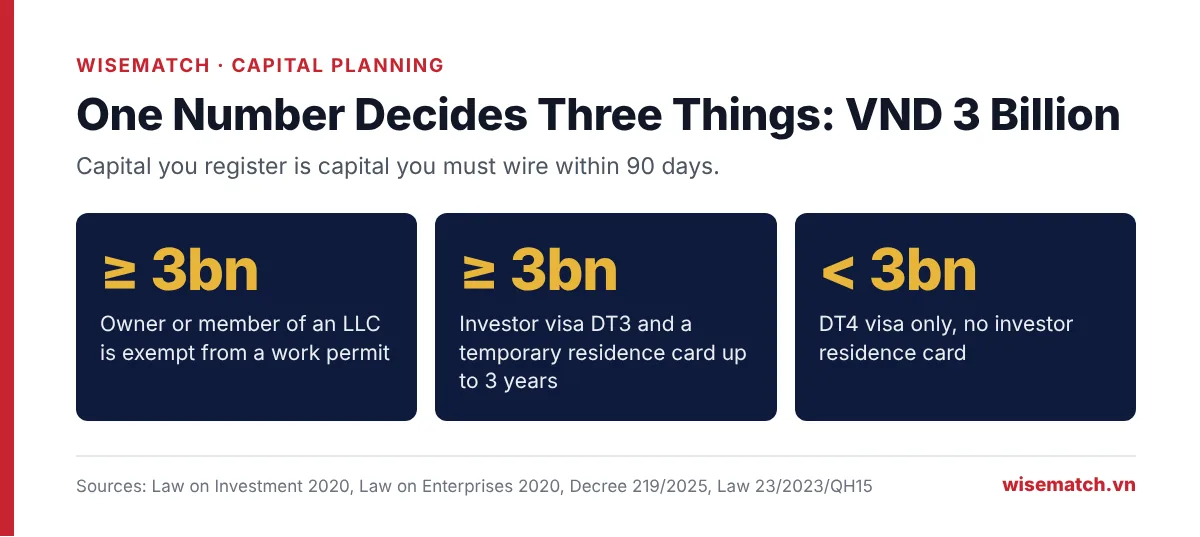
This threshold is worth deciding at the start. The same VND 3 billion is the floor for a DT3 investor visa and a temporary residence card of up to three years. A founder who registers VND 3 billion and contributes it within 90 days avoids both a work permit file and short visas. A founder who registers VND 2.5 billion faces both. The capital stays in the company as working capital; the question is whether the business needs that much cash in its first year anyway.
The Person Setting Up The Commercial Presence
A foreigner responsible for establishing a commercial presence in Vietnam is exempt while doing that job. This covers the founder or project lead who travels to set up the company or office before it operates.
Short Stays Under 90 Days A Year
Managers, executive directors, experts and technical workers whose total working time in Vietnam is under 90 days in a calendar year are exempt. The count runs from 1 January to 31 December, so plan visits across the year carefully. A regional manager who visits for a week every month stays under the limit; one who comes for three months in one go does not.
Intra-Company Transferees
Managers, executives, experts and technicians moved within a group that already has a commercial presence in Vietnam are exempt if they work in one of the 11 service sectors in Vietnam’s WTO commitments and have been employed by the group for at least 12 continuous months.
Priority Sectors Confirmed By A Ministry Or Province
Decree 219 adds an exemption for people confirmed by a ministry or provincial People’s Committee to work in finance, science, technology, innovation, national digital transformation or other priority sectors. This is new, and procedures are still settling; we treat it case by case.
Most exemptions are not automatic. Depending on the category, the employer either obtains a written confirmation that the person does not need a permit, or notifies the authority. Working without either is treated the same as working without a permit.
How To Get A Work Permit In Vietnam, Step By Step
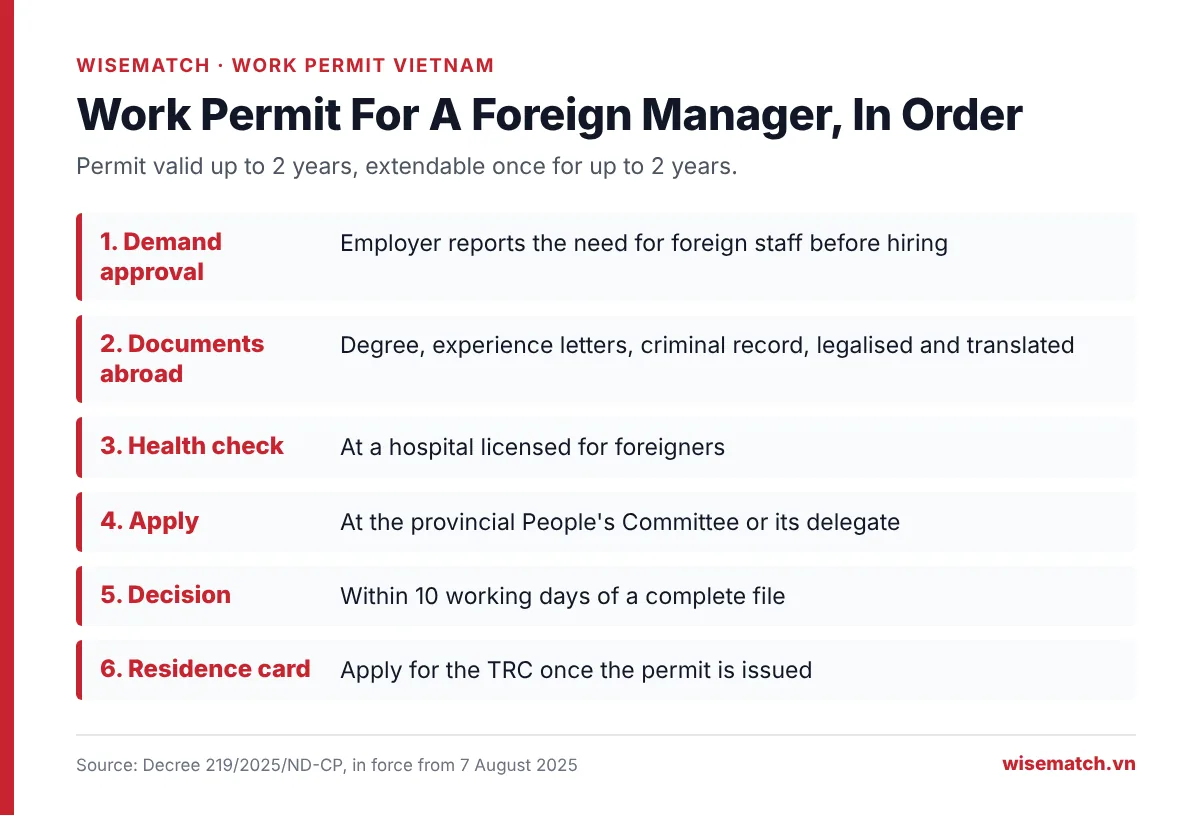
1. Confirm The Category And The Exemption Test
Start with the person’s role and contribution. If an exemption fits, the file is shorter. If not, decide which category (manager, executive, expert or technical worker) the documents can prove.
2. Collect Documents Abroad
The core file is the application and demand explanation on Form 03, a health certificate, a valid passport, a criminal record certificate, two 4 x 6 cm colour photos with a white background, proof of the working arrangement (assignment letter, contract or transfer), and proof of the person’s category. The criminal record certificate must be issued no more than six months before the file is lodged. Foreign documents must be legalised by a Vietnamese embassy or consulate and translated into Vietnamese. Vietnam is not a party to the Apostille Convention, so an apostille alone is not enough.
3. Health Check
A health certificate from a qualified facility is required. A certificate issued abroad is accepted only where Vietnam and that country recognise each other’s certificates, and it is valid for 12 months from issue. Most applicants take the check in Vietnam at a hospital licensed to examine foreigners.
4. Lodge The File
The employer files within 60 days, and at least 10 days, before the planned start date, at the provincial public service centre or online.
5. Decision
The authority approves the demand and issues the permit within 10 working days of a complete file. A refusal must be in writing with reasons within 3 working days.
6. Labour Contract And Residence Card
After the permit, the employer and employee sign a labour contract consistent with it. Then apply for the temporary residence card.
Temporary Residence Card Vietnam
A temporary residence card lets a foreigner live in Vietnam and travel in and out without new visas. It is issued by the Immigration Department or the provincial police immigration office, based on the visa category the person qualifies for.
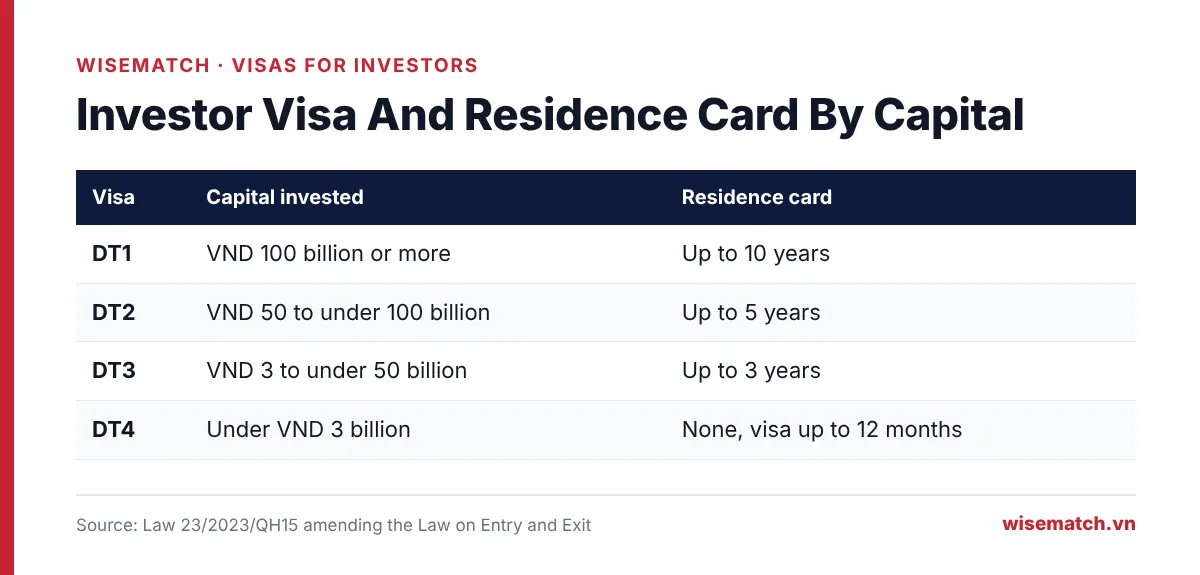
| Basis | Visa symbol | Maximum TRC length |
|---|---|---|
| Work permit holder | LD2 | Up to 2 years, in line with the permit |
| Exempt from work permit | LD1 | Up to 2 years |
| Investor, VND 100 billion or more | DT1 | Up to 10 years |
| Investor, VND 50 to under 100 billion | DT2 | Up to 5 years |
| Investor, VND 3 to under 50 billion | DT3 | Up to 3 years |
| Investor, under VND 3 billion | DT4 | No TRC; visa up to 12 months |
Source: Law on Entry and Exit of Foreigners, as amended by Law 23/2023/QH15.
Family members can receive dependent TRCs linked to the main holder. A TRC must be renewed before it expires, and when the underlying permit or investment changes, the card must follow.
Visas Before The Permit
Many founders first come to Vietnam on an e-visa or visa exemption, for a trade fair or for meetings. Vietnam issues e-visas to citizens of all countries, valid up to 90 days with single or multiple entry, under Resolution 127/NQ-CP. Citizens of twelve countries, including Germany, France, the United Kingdom, Japan and South Korea, can stay up to 45 days without a visa under Resolution 44/NQ-CP, valid until 14 March 2028. These are fine for market visits and for exhibiting at shows such as Vietfood Ho Chi Minh City 2027 or Vietfood Hanoi 2026. They are not permission to work. Once a person starts working for the Vietnamese entity, the work permit or exemption must be in place.

Timeline For A New Company Hiring Its First Foreign Manager
| Stage | Typical duration | Notes |
|---|---|---|
| IRC and ERC for the company | About 1 to 2.5 months | Statutory 15 + 3 working days; see our IRC and ERC guide |
| Documents legalised abroad | Run in parallel with licensing | Criminal record must be under 6 months old at filing |
| Health check in Vietnam | A few days | On arrival |
| Work permit decision | 10 working days | From a complete file |
| Temporary residence card | About 5 working days | Statutory time at Immigration |
The trap is the six-month limit on the criminal record certificate. If you obtain it too early, while the company licence is still pending, it expires before you can file. We schedule it to arrive just after the ERC.
Four Cases We Plan Most Often
The rules are easier to apply through real situations. These four are composites of files we handle, with names removed.
The Founder Who Will Live In Ho Chi Minh City
A European founder sets up a single-member LLC to import food products and plans to run it full time. With charter capital of VND 3 billion or more, contributed within 90 days, the founder is exempt from a work permit and qualifies for a DT3 visa and a residence card of up to three years. With less capital, the founder needs a full work permit as a manager, with degree and experience documents legalised abroad, and an LD2 visa. We model both options before the investment file is signed, because changing capital later means amending the investment certificate.
The Sales Director Hired From Abroad
A company hires an experienced sales director from Singapore. No exemption applies, so the employer applies for a work permit as a manager or expert. The critical path is the criminal record certificate from every country where the person lived recently, which must be legalised and still under six months old on filing day. We start the request for that certificate the week the job offer is signed.
The Technician Who Installs Machinery
A machinery supplier sends a technician to install a packaging line sold at a trade show. If the technician’s total working days in Vietnam stay under 90 in the calendar year, the work permit exemption for short assignments applies, but the paperwork for the exemption must still be in order and the visa must suit the purpose. If installation and training stretch past 90 days, a permit is needed. Machinery exhibitors at Vietfood & Beverage – ProPack often face this question after the show.
The Regional Manager Who Visits Monthly
A regional manager based in Bangkok visits the Vietnamese subsidiary for a few days each month. As long as the total stays under 90 days a year, no permit is needed. We suggest keeping a simple log of days in Vietnam, because the count is per calendar year and is easy to lose track of.
Extending, Changing Or Ending A Work Permit
A work permit is tied to one employer, one position and one place of work. Under the Labour Code 2019, it ceases to be valid when the labour contract ends, when the content of the job changes from what the permit states, or when the permit expires. A move to another company, even within the same group, generally needs a new permit or a new exemption. A promotion that changes the role on paper may need one too.
The permit can be extended once, for up to two years. Apply for the extension before the current permit expires, using the same category evidence and the employer’s updated explanation of need. After the single extension, a new permit is required. When the residence card is linked to the permit, renew the card after the permit, not before, so the two dates match.
When a foreign employee leaves, the employer should report it and return the permit as required, and the residence card should be cancelled or replaced. Loose ends here show up later, when the same person applies for a new permit with another employer.
Common Reasons A Work Permit File Is Returned
Degree Or Experience Does Not Match The Role
An expert file with a degree in an unrelated field, or experience letters that do not state dates and positions, is the most frequent problem.
Documents Not Legalised Or Translated Properly
Notarised copies made abroad without consular legalisation, or translations without a Vietnamese notarial certificate, are not accepted.
Expired Criminal Record Or Health Certificate
Both have limited validity. Plan the order of collection so they are current on filing day.
Company Details Out Of Date
If the company’s address, legal representative or business lines changed and the ERC was not updated, the authority may ask for consistency first.
Working Before The Permit Is Issued
Starting work on a business visa while the permit is pending exposes both employer and employee to penalties, and in serious cases deportation.

How Wisematch Helps
We handle the work permit as part of setting up a foreign company in Vietnam: deciding whether the founder should qualify for exemption, scheduling documents so nothing expires, preparing Form 03 and the category proof, and following through to the temporary residence card. Our founder, Maximillien Quan Pham, works with a licensed legal adviser on every file. If you are still deciding whether to come, our guide on how to start a business in Vietnam as a foreigner is the place to begin.
Related guides: company formation Vietnam, trading company Vietnam, and Wisematch in English.
Frequently Asked Questions About The Vietnam Work Permit
How Long Does A Work Permit Take In Vietnam?
10 working days from a complete file under Decree 219/2025. Collecting and legalising documents abroad usually takes longer than the decision itself.
How Long Is A Vietnam Work Permit Valid?
Up to two years, extendable once for up to two more years.
Do Company Owners Need A Work Permit?
Not if they own or contribute VND 3 billion or more to an LLC, or sit on the board of a JSC with a contribution of VND 3 billion or more. Below that amount, they apply as managers.
Can I Work In Vietnam On A Tourist Visa Or E-Visa?
No. An e-visa or visa exemption allows visits and meetings. Working requires a work permit or a confirmed exemption, and then the right visa or residence card.
Is There A Work Permit Exemption For Short Trips?
Yes. Managers, executives, experts and technical workers whose total work in Vietnam is under 90 days in a calendar year are exempt.
Who Issues Work Permits Now?
The provincial People’s Committee where the employer is based, or the body it delegates. The labour ministry and its provincial departments no longer issue them.
How Long Is A Temporary Residence Card Valid?
For a work permit holder, up to two years. For investors, up to 3, 5 or 10 years depending on capital (DT3, DT2, DT1). DT4 investors under VND 3 billion do not receive a TRC.
Can A Foreign Company Without A Vietnamese Entity Sponsor A Work Permit?
No. The employer must have a legal presence in Vietnam, such as a company, branch or representative office.

