
Company formation in Vietnam for a foreign investor means two licences in sequence: an Investment Registration Certificate (IRC) for the project, then an Enterprise Registration Certificate (ERC) for the company. By law that is 15 plus 3 working days. In practice, with document legalisation, office leasing, bank account opening and the 90-day capital deadline, a realistic plan from first call to an operating company is two to three months. This guide explains every step, the costs that matter, and the decisions that are hard to undo later.
Wisematch Vietnam helps foreign companies enter the Vietnamese market, from trade fairs such as Vietfood & Beverage – ProPack to setting up a local company when the market proves itself. What follows is based on the Law on Investment 2020, the Law on Enterprises 2020 and the decrees in force in October 2026, plus what we see on real files. Where something is our experience rather than a rule, we say so.

Company Formation In Vietnam In One Table
| Question | Short answer |
|---|---|
| Can a foreigner own 100% of a company in Vietnam? | Yes, in most sectors. Some sectors cap foreign ownership or require a Vietnamese partner |
| Most common structure | Single-member limited liability company (LLC) owned by the foreign parent or individual |
| Licences | IRC, then ERC. Trading and retail need extra licences |
| Who issues them | The provincial Department of Finance, or the industrial zone management board inside an IZ |
| Statutory time | IRC 15 working days, ERC 3 working days, counted from a complete file |
| Minimum capital | No general minimum. Capital must match the project, and some regulated sectors set their own |
| Capital deadline | Fully contributed within 90 days of the ERC |
| Corporate income tax | 20% standard, 15% or 17% for small revenue bands from tax year 2025 |
| Work permit exemption | LLC owners or members contributing VND 3 billion or more |
Sources: Law on Investment 2020, Law on Enterprises 2020, CIT Law 67/2025/QH15, Decree 219/2025/ND-CP.
Which Structure Should A Foreign Company Choose?
Before any paperwork, decide what the Vietnamese entity must do. The answer usually comes down to one question: do you need to invoice customers in Vietnam, or do you only need to be present?
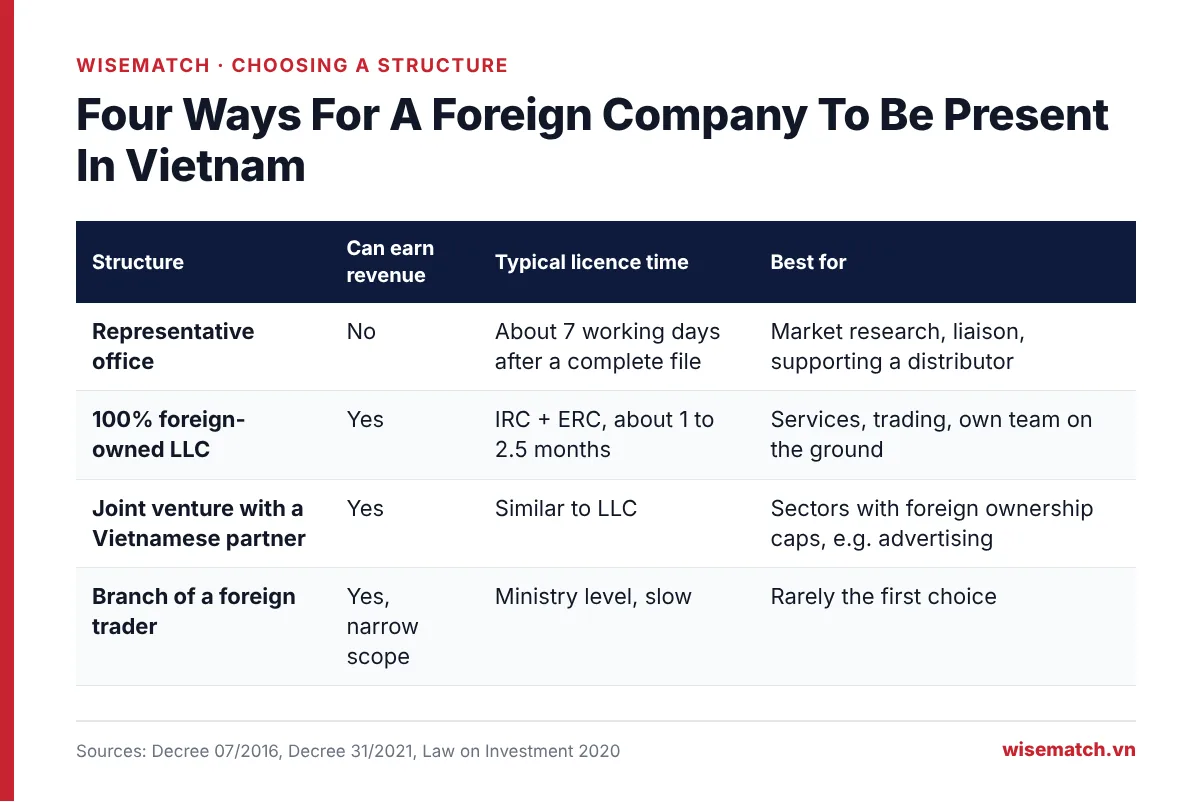
Representative Office
A representative office (RO) is the lightest presence. It can do market research, meet buyers, support distributors and promote the parent company. It cannot sell, issue invoices or earn revenue in Vietnam. The parent must have operated for at least one year, and the licence lasts five years. For a food or consumer brand testing the market, an RO plus a distributor is often the right first step. Our guide to the representative office in Vietnam covers the file, the limits and when to convert.
100% Foreign-Owned Limited Liability Company
The single-member LLC is the standard vehicle for a foreign company or individual who wants to trade, hire staff and sign contracts locally. Liability is limited to charter capital. A multi-member LLC (two to fifty members) suits partners who invest together. A joint stock company is used when you expect many shareholders or a later listing, but it carries heavier governance rules and is rarely the right first choice for a small team.
Joint Venture With A Vietnamese Partner
Some sectors either cap foreign ownership or require a local partner. Advertising is a common example that surprises marketing and trade-promotion companies: under Vietnam’s WTO commitments, foreign investors provide advertising services through a joint venture or a business cooperation contract with a licensed Vietnamese advertising business. Check the market access list in Decree 31/2021/ND-CP for your exact activity before choosing a structure.
Branch Of A Foreign Trader
Branches exist in law but are rarely the practical route for a first entry. The parent must have operated for at least five years and the scope is narrow. We mention it because some investors ask for it by name. In almost every case a subsidiary works better.
How To Set Up A Company In Vietnam, Step By Step
The sequence below is the critical path for a new 100% foreign-owned LLC outside an industrial zone. Each step depends on the previous one, which is why delays compound.
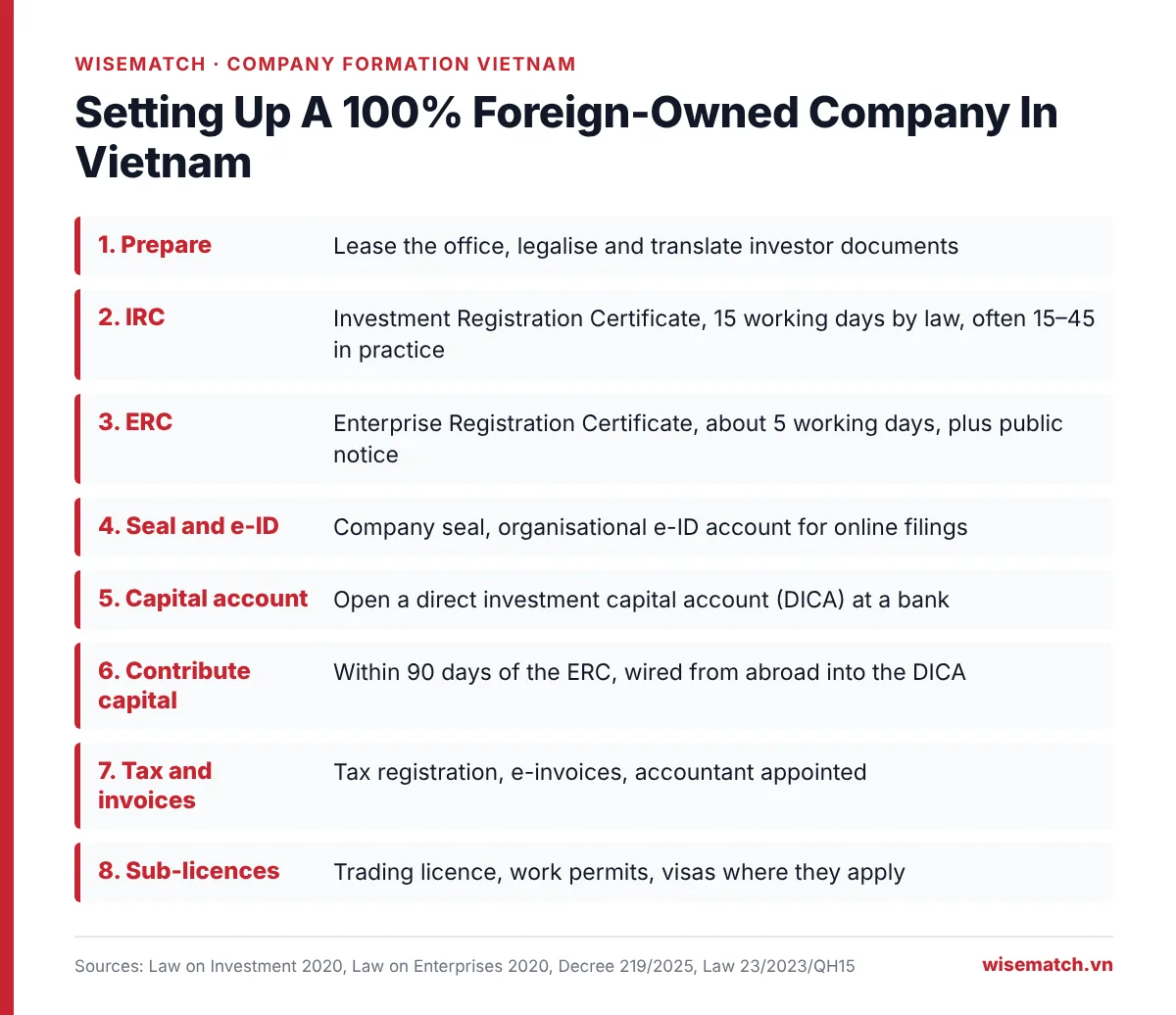
1. Prepare Documents And An Office
You need a real office address before you file. A lease or a memorandum of lease is part of the IRC file. Two points catch foreigners out. First, apartments in residential condominiums cannot be used as a business office under the Housing Law, so the cheap option of using your flat does not work. Second, a serviced or shared office is accepted by most licensing desks if the lease is in order, but some activities, such as warehousing or retail, need premises that suit the activity.
For a corporate investor, the parent’s certificate of incorporation and audited financial statements (or a bank confirmation of funds) must be legalised by the Vietnamese embassy or consulate, then translated and notarised in Vietnam. Vietnam is not a party to the Apostille Convention, so an apostille alone is not enough. For an individual investor, a passport copy and a bank statement showing funds are the core. In our experience, consular legalisation abroad is the step that most often stretches the timeline, so start it the same week you decide to invest.
2. Investment Registration Certificate
The IRC licenses the investment project: who invests, how much, in what, where and for how long. The statutory time is 15 working days from a complete file. In practice we plan 15 to 45 working days, because the licensing officer often asks questions about the scope, the capital or the lease, and each round restarts part of the clock. Since the 2025 government restructuring, the provincial Department of Finance handles this work that the Department of Planning and Investment used to do. Projects inside an industrial zone go to the zone’s management board instead. Our page on the IRC and ERC in Vietnam shows what each certificate contains and what triggers an amendment later.
3. Enterprise Registration Certificate
The ERC creates the legal entity and gives it an enterprise code, which is also its tax code. The statutory time is three working days; we plan about five, plus two for publication on the National Business Registration Portal. The company name, address, charter capital, legal representative and owner are fixed here, so changing them later means a new filing.
4. Seal, E-ID And Initial Filings
Companies make their own seal. Since 1 July 2025, organisations use an electronic identification account for online public services, so the company sets this up early, through its legal representative. The same period is used to register the e-invoice system and appoint a chief accountant or an accounting service.
5. Direct Investment Capital Account
A foreign-invested company must open a direct investment capital account (DICA) at a licensed bank in Vietnam. Capital from the foreign investor goes into this account, and later profit repatriation comes out of it. Banks ask for the IRC, ERC, charter and identification of the legal representative. Allow one to two weeks, longer if the legal representative is abroad.
6. Contribute The Capital Within 90 Days
The investor must contribute the full registered charter capital within 90 days from the date of the ERC. Missing the deadline forces a reduction of charter capital and can lead to penalties. This is why the amount you write in the file matters more than many investors think: registering a large capital to look serious creates a legal obligation to wire it within three months.
7. Tax, Accounting And Reporting
From the first month the company files tax declarations, even with no revenue. Foreign-invested companies also file investment reports and audited annual financial statements. Most small foreign-owned companies use an outside accounting firm. The business licence fee, a small annual levy that every company used to pay, was abolished from 1 January 2026 under Resolution 198/2025/QH15.
8. Sub-Licences, Work Permits And Visas
Some activities need a further licence once the company exists. A foreign-invested company that wants to retail goods, or provide trade promotion, brokerage or e-commerce platform services, needs a business licence under Decree 342/2026/ND-CP, which replaces Decree 09/2018 from 18 October 2026. Our guide to the trading company in Vietnam explains these licences. Foreign managers need a work permit or an exemption, followed by a temporary residence card. See the work permit Vietnam guide.
The VND 3 Billion Decision Most Guides Miss
Most company formation guides treat charter capital and visas as separate topics. They are linked by one number, and getting it right at the IRC stage saves a second filing later.
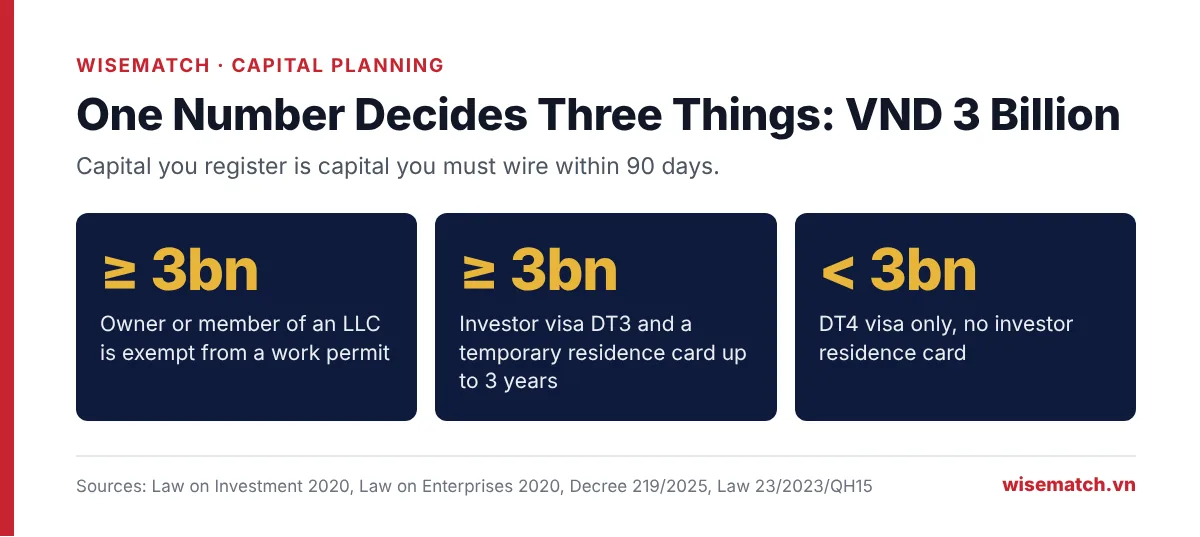
Under Decree 219/2025/ND-CP, in force since 7 August 2025, the owner of a single-member LLC, or a member of a multi-member LLC, whose capital contribution is VND 3 billion or more does not need a work permit. Under the Law on Entry and Exit as amended by Law 23/2023/QH15, an investor who invests VND 3 billion to under VND 50 billion qualifies for a DT3 visa and a temporary residence card of up to three years. Below VND 3 billion, the investor gets a DT4 visa only, of up to 12 months, and no investor residence card.
So a founder who plans to live in Vietnam and run the company has a real choice. Register VND 3 billion or more, contribute it within 90 days, and both the work permit exemption and the three-year residence card follow. Register less, and you face a full work permit application with degree and experience documents, plus shorter visas. The money is not a fee: it stays in the company as working capital. Whether it makes sense depends on how much cash the business really needs in year one. We model both options with clients before the IRC file is signed.
How Much Does It Cost To Set Up A Company In Vietnam?
State fees for the IRC and ERC are small. The real costs sit elsewhere, and they are what a budget should cover.
| Cost item | When it hits | What drives it |
|---|---|---|
| Legalisation and translation of parent documents | Before filing | Number of documents, embassy fees in your country |
| Office lease | Before filing, usually 6 to 12 months upfront plus deposit | City, building grade, serviced or traditional |
| Licensing service | During IRC and ERC | Sector, number of investors, special licences |
| Charter capital | Within 90 days of ERC | Your business plan; stays in the company |
| Accounting and tax filing | Monthly from month one | Number of invoices, payroll size |
| Annual audit | Every year | Required for foreign-invested companies |
| Work permits and residence cards | After ERC | Number of foreign staff |
We do not publish service prices because they depend on the sector and the investor structure. Send us your planned activity and we will reply with a written quote and timeline.
Corporate Tax Rate In Vietnam
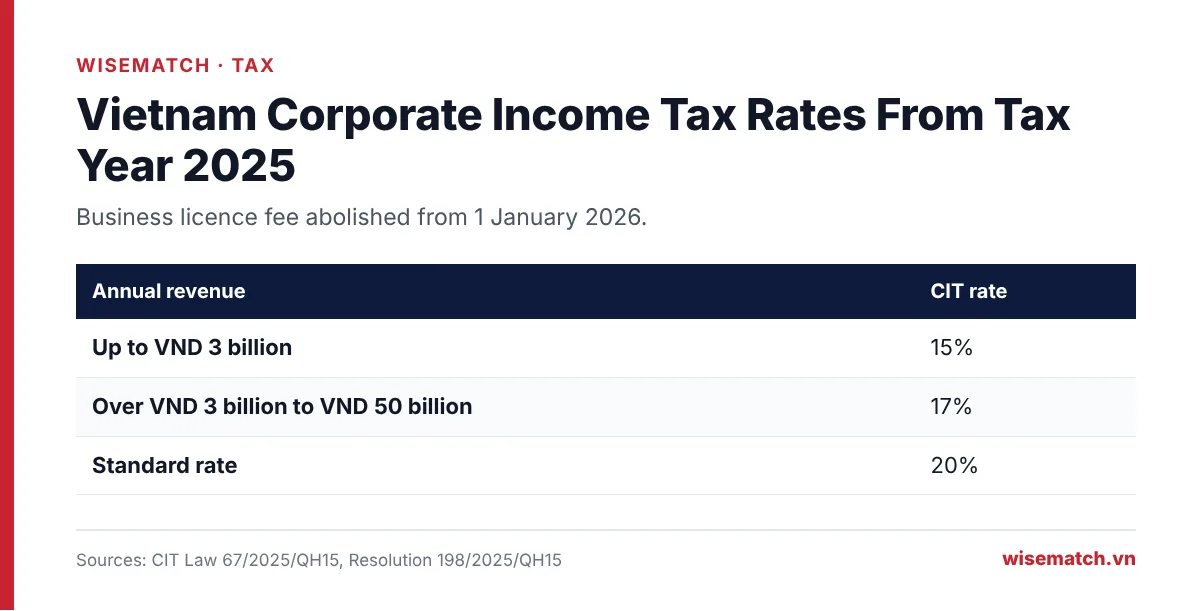
The new Corporate Income Tax Law 67/2025/QH15 applies from tax year 2025. The standard rate stays at 20%. Companies with annual revenue up to VND 3 billion pay 15%, and those with revenue over VND 3 billion up to VND 50 billion pay 17%. Incentive rates for encouraged sectors and locations remain, and they are set out in the IRC, so mention any qualifying activity at the start. Value added tax, personal income tax for staff, and withholding on payments abroad are separate topics your accountant will handle.
Foreign Ownership Limits And Restricted Sectors
Vietnam lists sectors closed to foreign investors and sectors with conditions in Decree 31/2021/ND-CP. Most manufacturing, software, consulting and wholesale activities are open to 100% foreign ownership. Areas that commonly need care include advertising, logistics sub-sectors, tourism, education and some distribution activities. The practical test is simple: write down the activities you will actually invoice for in the first two years, then check each against the market access list and Vietnam’s commitments under WTO, CPTPP or EVFTA, depending on where the investor is from. Adding a restricted activity late usually means an IRC amendment and sometimes a new partner.

Ho Chi Minh City Or Hanoi?
Most foreign companies register in Ho Chi Minh City or Hanoi. The legal procedure is the same, run by each city’s Department of Finance. The difference is commercial. Ho Chi Minh City is the centre of trade, consumer goods and food distribution in the south. Hanoi is closer to government, northern industry and the capital’s hotel and retail networks. Northern and southern Vietnam run largely separate distribution networks, which is why some companies register in one city and add a branch or a business location in the other later.
One way to decide is to go to market first. Exhibitors at Vietfood Ho Chi Minh City 2027 or Vietfood Hanoi 2026 meet the distributors and buyers of each region in one week, and the response tells you where the company should sit.

Five Mistakes We See In Foreign Company Formation
Choosing The Scope Too Narrowly
The IRC lists your business lines. If you later want to import your own product, offer after-sales service or sell online, each new line can mean an amendment. Spend an hour on the scope before filing.
Registering Capital You Cannot Wire In 90 Days
The capital deadline is fixed. If the parent company’s own approvals for the transfer take longer, register a smaller amount and increase it later.
Appointing A Legal Representative Who Is Rarely In Vietnam
At least one legal representative must reside in Vietnam. If that person is the foreign founder and travels a lot, bank, tax and e-ID steps stall. Many companies appoint two legal representatives, one resident manager and one founder.
Signing A Lease Before The Address Is Checked
Residential apartments are not accepted, and some buildings lack the paperwork licensing officers want to see. Check the landlord’s documents before you pay a deposit.
Forgetting The Licences After The ERC
The ERC is not permission to do everything. Retail, trade promotion and several other activities need a business licence under Decree 342/2026/ND-CP. Starting before it arrives is a common cause of fines.
What To Expect From Vietnam Company Formation Services
A competent provider should give you three things before you pay: a written timeline with the statutory and realistic durations, a list of every document by name and who signs it, and a clear answer on whether your activities are open to foreign investors. Be careful with promises of an IRC in a week for any sector, and with providers who suggest a Vietnamese nominee shareholder to avoid foreign ownership rules. Nominee arrangements are not recognised in law and leave the real investor without protection.
Wisematch handles company formation as part of market entry. Because we also run trade fair sales, distributor searches and trade missions, the company we set up is shaped around how you will actually sell, not only around the licence. Our founder, Maximillien Quan Pham, works with a licensed legal adviser on every file.
Related Guides In This Series
- How to start a business in Vietnam as a foreigner: the decisions before you file, for individuals and small teams.
- IRC and ERC in Vietnam: what each certificate covers and when it must be amended.
- Work permit Vietnam: Decree 219/2025, exemptions, and the temporary residence card.
- Representative office in Vietnam: the low-cost presence and its limits.
- Trading company in Vietnam: import, wholesale, retail and the new Decree 342/2026.
Vietnamese readers looking to set up a company abroad can see our overseas company formation service. More about us on Wisematch in English.
Frequently Asked Questions About Company Formation In Vietnam
Can A Foreigner Own 100% Of A Company In Vietnam?
Yes, in most sectors. Some activities, such as advertising, require a Vietnamese partner, and others have ownership caps. Check Decree 31/2021/ND-CP for your activity.
How Long Does Company Registration In Vietnam Take?
By law, 15 working days for the IRC and 3 for the ERC. With document preparation, bank account and capital, plan two to three months from start to an operating company.
What Is The Minimum Capital For A Company In Vietnam?
There is no general minimum. The capital must be enough for the project you describe, and some regulated sectors set their own minimum. Capital of VND 3 billion or more brings work permit exemption for LLC owners and a DT3 investor visa.
Do I Need A Local Director?
At least one legal representative must reside in Vietnam. It can be a foreigner with a residence card, or a Vietnamese manager.
Can I Use My Apartment As The Company Address?
No. Residential condominium apartments cannot be used as business offices. Use a commercial or serviced office with a proper lease.
What Is The Corporate Tax Rate In Vietnam?
20% standard. From tax year 2025, 15% for annual revenue up to VND 3 billion and 17% for revenue over VND 3 billion up to VND 50 billion.
Who Issues The IRC And ERC Now?
The provincial Department of Finance, which took over the investment and business registration work of the former Department of Planning and Investment in 2025. Industrial zone projects go to the zone’s management board.
Is A Representative Office Cheaper Than A Company?
Usually yes to set up and run, but an RO cannot earn revenue. If you need to invoice in Vietnam, you need a company.

