
To start a business in Vietnam as a foreigner, you choose one of three paths: sell through a Vietnamese distributor, open a representative office, or set up your own company, usually a 100% foreign-owned limited liability company. Each path has a different cost, speed and level of control. This guide is for founders, small teams and export managers who are deciding which path fits, and what to do in the first six months so that the decision is based on the market rather than on paperwork.
Wisematch Vietnam helps foreign companies enter the Vietnamese market, as official sales agent for the Vietfood & Beverage – ProPack trade fair and as a market entry and company formation adviser. What follows is what we tell clients in the first meeting, before any licence is discussed.

The Three Ways To Do Business In Vietnam
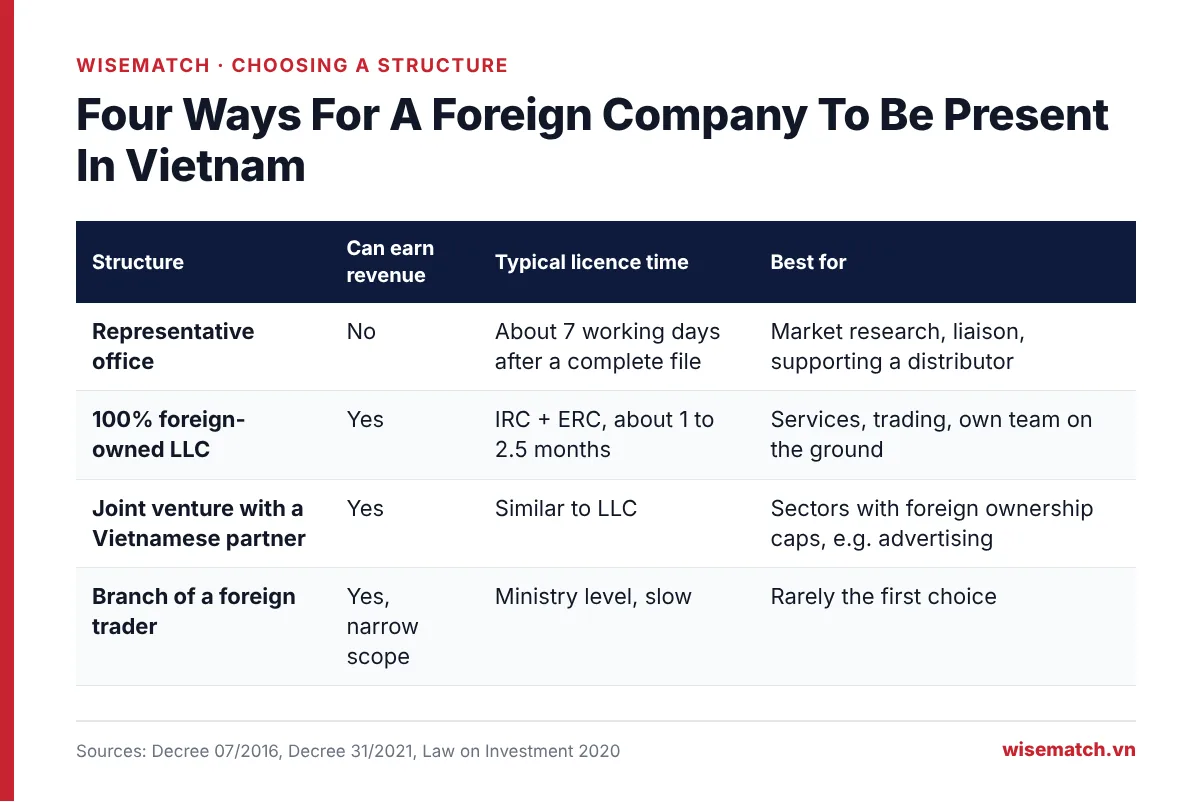
| Path | You need | Time to start | Control | Good for |
|---|---|---|---|---|
| Export to a Vietnamese distributor or buyer | A contract; the buyer imports | Weeks | Low to medium | Testing demand, limited budget |
| Representative office | Licence from the Department of Industry and Trade | About one month after documents are ready | Medium | Supporting a distributor, sourcing, research |
| Own company | IRC, ERC, bank account, capital in 90 days | About two to three months | Full | Importing, invoicing, hiring, long-term presence |
Most successful entries we have seen move through these in order. A brand sells through a distributor, learns the market, adds an office or a local manager, and sets up a company when volume justifies it. Jumping straight to a company is right in some cases, such as service businesses that must invoice locally, or founders who intend to live in Vietnam, but it is not the default.
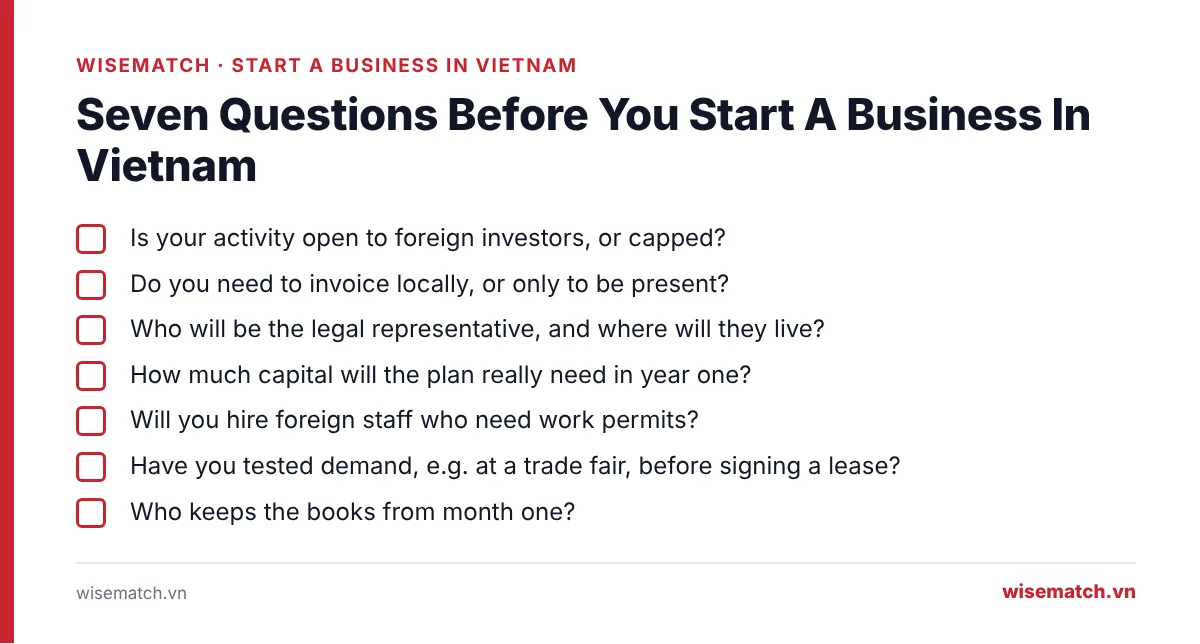
Seven Questions To Answer Before You Start
1. Is Your Activity Open To Foreign Investors?
Most manufacturing, wholesale, consulting and technology activities are open to 100% foreign ownership. Some, such as advertising, require a Vietnamese partner, and others have caps or conditions. Vietnam’s market access list is in Decree 31/2021/ND-CP. Check your actual revenue activities, not just your industry label.
2. Do You Need To Invoice In Vietnam?
If customers in Vietnam must receive a Vietnamese VAT invoice from a local entity, you need a company. If they can buy from your parent company abroad, or through a distributor, you may not.
3. Who Will Be The Legal Representative?
A company needs at least one legal representative who resides in Vietnam. If that is you, you will need a work permit or an exemption, and a residence card. If you will not live here, plan for a trusted resident manager.
4. How Much Capital Will Year One Really Need?
There is no general minimum capital, but the capital you register must be wired within 90 days, and it shapes your visa: VND 3 billion or more makes an LLC owner exempt from a work permit and eligible for a DT3 investor visa with a residence card of up to three years. Below that, the founder needs a work permit and receives shorter visas. Our work permit Vietnam guide sets out the thresholds.
5. Will You Hire Foreigners?
Each foreign employee needs a work permit or a confirmed exemption. Under Decree 219/2025/ND-CP, permits are decided within 10 working days of a complete file, but collecting legalised documents abroad takes longer.
6. Have You Tested Demand?
A lease, a licence and a team are expensive ways to discover that the price is wrong. A week at a trade fair, with meetings set up in advance, tells you more about price, channel and competition than months of desk research.
7. Who Keeps The Books From Month One?
Companies file tax declarations from the first month, even without revenue. Foreign-invested companies also need an annual audit. Most small companies use an outside accounting firm from day one.
Test The Market Before You Form A Company
For food, beverage, packaging and consumer goods, the fastest test is a specialised trade fair. Vietfood & Beverage – ProPack, the main food and beverage show, runs twice a year: in Hanoi from 4 to 7 November 2026, and in Ho Chi Minh City from 12 to 14 August 2027. The 2026 Ho Chi Minh City edition reported 1,000 exhibitors and 39,150 visitors, of whom 27,400 were trade visitors, according to the organiser VINEXAD.

We suggest foreign companies go with three goals: meet at least five distributors in your category, collect real price points from buyers, and learn which product registrations distributors expect. Our guides to Vietfood Ho Chi Minh City 2027 and Vietfood Hanoi 2026 explain the visitor profile, the country pavilions and how to prepare.
You do not need a Vietnamese entity to exhibit or to visit. Vietnam issues e-visas of up to 90 days to citizens of all countries, and citizens of twelve countries, including Germany, France, the UK, Japan and South Korea, can stay up to 45 days without a visa until 14 March 2028. Meetings and trade fairs are fine on these. Working for a Vietnamese entity is not.
Choosing Between Distributor, Office And Company
When A Distributor Is Enough
A distributor fits when your product sells through established channels such as modern trade, traditional trade or food service, and the distributor already covers them. Agree in writing who holds product registrations, which region the distributor covers, and how you will see sell-out data. Northern and southern Vietnam often need different distributors.
When To Add A Representative Office
An office fits when the distributor needs active support, such as training, tastings, promotions and key account visits, and you want your own people on the ground. It cannot sell or invoice, but its head is exempt from a work permit. See our guide to the representative office in Vietnam.
When To Set Up A Company
A company fits when you must import, hold stock, invoice, sign contracts locally or bid for projects, or when the founder will live in Vietnam on an investor visa. The steps, timeline and costs are in our company formation Vietnam guide. If the business is about importing and selling goods, also read our guide to the trading company in Vietnam, which covers the new Decree 342/2026.
Ho Chi Minh City, Hanoi Or Elsewhere
The legal steps are the same everywhere, handled by each province’s Department of Finance. The commercial picture differs. Ho Chi Minh City is the main hub for consumer goods, food distribution, logistics and services in the south. Hanoi is the political capital and the hub for the north, with its own distributors, retail chains and hotel and restaurant market. Manufacturing projects often choose industrial zones in surrounding provinces such as Binh Duong, Dong Nai, Bac Ninh or Hai Phong, where the zone’s management board handles the investment certificate.

Practical Realities Of Doing Business In Vietnam
Relationships Before Contracts
Vietnamese buyers and distributors often want to meet several times before committing. A first meeting at a trade fair, a factory or office visit, and a meal are normal steps. Plan repeat visits, not a single trip.
Zalo Is The Business Messenger
Most Vietnamese business people use Zalo for daily communication, often more than email. Set up an account before your first trip, and expect quick replies and voice messages.
Tet Shapes The Calendar
The Lunar New Year holiday closes much of the economy for about a week or more, usually in late January or February. Orders for the Tet season are placed months ahead, and decisions slow in the weeks around it. Plan launches and licence filings with this in mind.
Vietnamese Documents Rule
Licences, contracts with state bodies and filings are in Vietnamese. Bilingual contracts are common in business, but agree which language prevails. Budget for good translation.
Paperwork Is Literal
Licensing officers check that names, addresses and numbers match exactly across documents. A missing middle name or an old address on one document can return a file. This is why preparation takes longer than the statutory timelines suggest.
Foreign Investment In Vietnam, The Legal Framework In Brief
| Topic | Main law in force |
|---|---|
| Investment registration | Law on Investment 2020 |
| Company formation and governance | Law on Enterprises 2020 |
| Market access for foreign investors | Decree 31/2021/ND-CP |
| Trading and retail by foreign-invested companies | Decree 342/2026/ND-CP from 18 October 2026 |
| Representative offices and branches | Decree 07/2016/ND-CP |
| Work permits | Decree 219/2025/ND-CP from 7 August 2025 |
| Visas and residence cards | Law on Entry and Exit, amended by Law 23/2023/QH15 |
| Corporate income tax | Law 67/2025/QH15, from tax year 2025 |
In 2025 Vietnam reorganised its government. The Ministry of Planning and Investment merged into the Ministry of Finance, and provincial investment registration moved to the provincial Departments of Finance. Work permits moved to provincial People’s Committees. Guides written before mid-2025 often name the old bodies.
A Six-Month Plan For A Foreign Brand
| Month | Action |
|---|---|
| 1 | Desk check: market access for your activity, product registration needs, competitor prices online |
| 2 | Book a trade fair or a buyer meeting programme; prepare Vietnamese sales material and samples |
| 3 | Trade fair or market visit; meet distributors and buyers; collect price feedback |
| 4 | Shortlist and visit distributors; agree registration ownership and territory |
| 5 | First order through a distributor, or decide on an office or company |
| 6 | If forming a company: start legalising documents and choose an office |
How Wisematch Helps Foreigners Start A Business In Vietnam
We cover both sides of market entry. On the market side, we sell trade fair space, set up buyer and distributor meetings, translate sales material and support trade missions. On the legal side, we set up companies and representative offices, handle the investment and enterprise certificates, and coordinate work permits and residence cards with a licensed legal adviser. Our founder, Maximillien Quan Pham, leads market entry projects. More about us on Wisematch in English, and on the details of each licence in our IRC and ERC guide.
Frequently Asked Questions About Starting A Business In Vietnam
Can A Foreigner Start A Business In Vietnam?
Yes. A foreigner can own 100% of a company in most sectors, open a representative office for a foreign company, or work with a Vietnamese distributor.
What Is The Easiest Way To Start?
Selling through a Vietnamese distributor, after testing demand at a trade fair. It needs no local entity.
How Long Does It Take To Set Up A Company?
By law, 15 working days for the investment certificate and 3 for the enterprise certificate. With preparation, bank account and capital, plan two to three months.
Do I Need A Vietnamese Partner?
Not in most sectors. Some activities, such as advertising, require one. Avoid nominee arrangements, which have no legal protection.
Can I Live In Vietnam If I Start A Company?
Yes. An investor with VND 3 billion or more qualifies for a DT3 visa and a residence card of up to three years, and is exempt from a work permit as an LLC owner. Below that, you need a work permit as a manager.
Can I Start A Business On A Tourist Visa?
You can visit, attend trade fairs and meet partners on an e-visa or visa exemption. You cannot work for a Vietnamese entity until a work permit or exemption is in place.
Which City Is Better For Business, Ho Chi Minh City Or Hanoi?
Ho Chi Minh City for consumer goods, food and services in the south; Hanoi for the north and government-related business. Many companies need distributors in both.
What Taxes Will My Company Pay?
Corporate income tax at 20% standard, with 15% and 17% for small revenue bands from tax year 2025, plus VAT and payroll taxes. The annual business licence fee was abolished from 2026.

