
A foreign-owned trading company in Vietnam can import, export and wholesale most goods with trading rights written into its investment certificate, but retail, and some services, need a separate business licence. From 18 October 2026 that licence is governed by Decree 342/2026/ND-CP, which replaces Decree 09/2018 and moves licensing to the provincial People’s Committee. This guide explains what a trading company may do, which licences apply to which activity, which goods are excluded, and what a food or consumer brand needs before the first container lands.
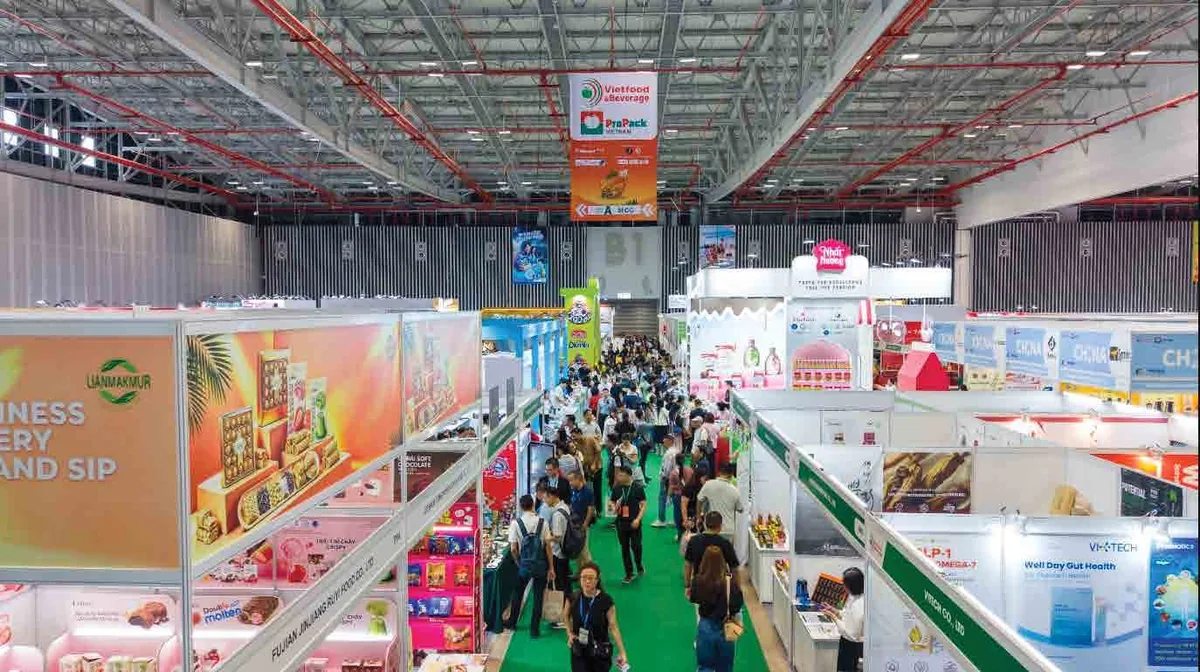
Wisematch is the official sales agent for Vietfood & Beverage – ProPack and helps foreign companies enter the Vietnamese market. Many exhibitors who find distributors at the show later ask whether they should import through their own company. This page is part of our company formation Vietnam series.
Trading Company Vietnam At A Glance
| Item | Position in October 2026 |
|---|---|
| Foreign ownership | Up to 100% for most goods under Vietnam’s WTO commitments |
| Import, export, wholesale | Rights recorded in the investment registration; most goods need no further business licence |
| Retail | Business licence plus a retail outlet licence for each shop |
| Second and later shops | Economic needs test, unless the shop is under 500 m2, inside a shopping mall, and not a convenience store, mini-market or supermarket |
| Licensing body | Provincial People’s Committee, under Decree 342/2026/ND-CP from 18 October 2026 |
| Reporting | Activity reports due 15 January (annual) and 15 July (half-year) |
| Product rules | Separate: food safety, labelling, product registration, specialised import permits |
Sources: Decree 342/2026/ND-CP as summarised by VCCI and Tap chi Cong Thuong; Vietnam’s WTO Schedule of Specific Commitments.
What Changed With Decree 342/2026
Decree 09/2018 governed foreign-invested trading for eight years. Its replacement, Decree 342/2026/ND-CP, takes effect on 18 October 2026. For a new trading company, four changes matter.
Licensing Moves To The Province
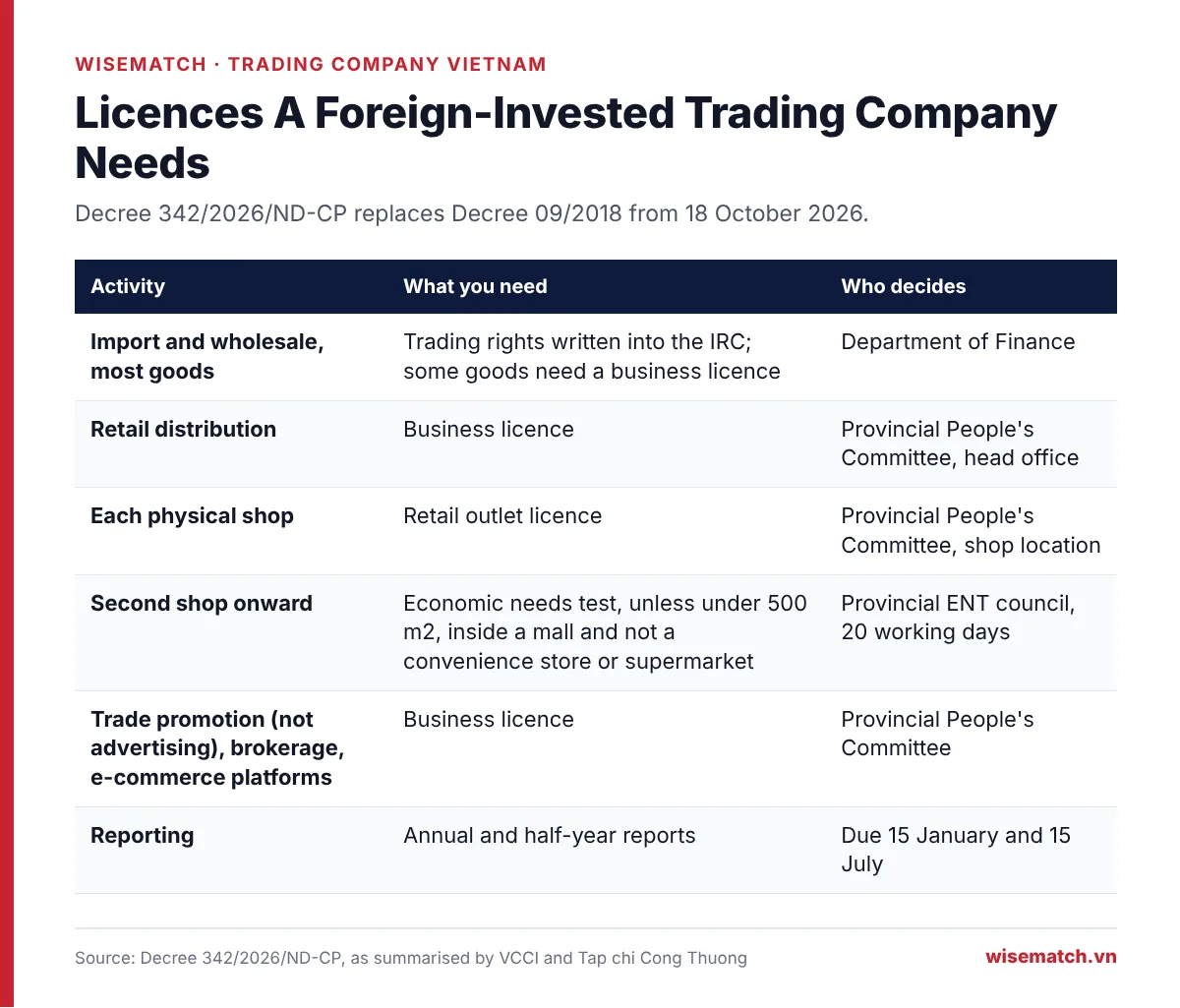
The provincial People’s Committee where the company has its head office issues, amends and revokes the business licence. The provincial People’s Committee where a shop is located issues the retail outlet licence. Under the old decree, the Department of Industry and Trade handled files and the Ministry of Industry and Trade gave opinions in many cases.
A Clearer Economic Needs Test
The economic needs test (ENT) applies to investors from countries without a treaty commitment to remove it, when they open a second or later shop. A shop is exempt only if it meets all three conditions at once: under 500 m2 of sales area, located in a shopping mall, and not a convenience store, mini-market or supermarket. The provincial ENT council decides within 20 working days of a complete file. The market area assessed is the ward or commune for shops under 5,000 m2, and the province or city for larger ones.
A Security Review For Large Networks
Ministries of Public Security and National Defence are consulted when a retail network reaches a set scale, such as 100 shops under 500 m2. This does not affect a company opening its first few outlets.
Fixed Reporting Dates
Licensed companies report on their trading activities by 15 January for the previous year and by 15 July for the first half.
Which Activities Need A Business Licence?
The phrase “business licence” confuses many investors, because people also use it for the enterprise registration certificate. Under Decree 342/2026, the business licence is a separate document for a foreign-invested company that carries out these activities:
- Retail distribution of goods, with some exceptions
- Import and wholesale of certain goods, such as lubricants
- Logistics services not covered by Vietnam’s opening commitments
- Leasing of goods, excluding financial leasing and leasing of construction equipment with operators
- Trade promotion services, excluding advertising
- Commercial intermediary services, such as brokerage and agency
- Operating intermediary e-commerce platforms, e-commerce social networks and integrated platforms
- Organising bidding for goods and services
For import, export and wholesale of ordinary goods, a separate business licence is usually not required. The rights are set out when the company registers its investment. Our guide to the IRC and ERC in Vietnam explains how to describe those rights in the file.
Conditions For The Licence
The company must meet the market access conditions in the treaty that applies to its investors. If it has existed in Vietnam for a year or more, it must have no overdue tax debt when it files. For investors from countries without a relevant treaty, or for goods and services outside Vietnam’s commitments, the authority also looks at consistency with sector laws, competition from domestic businesses in the field over the previous year, and fit with national and local development plans.
Goods A Foreign-Invested Company Cannot Freely Distribute
Vietnam’s WTO commitments on distribution services exclude a short list of goods. For these, a foreign-invested company faces restrictions or needs special approval:
- Cigarettes and cigars
- Books, newspapers and magazines, and recorded media
- Precious metals and stones
- Pharmaceuticals
- Explosives
- Crude and processed oil
- Rice
- Cane and beet sugar
Decree 342/2026 adds detail: lubricants and petroleum-based greases may be imported and wholesaled only under specified conditions, and rice, sugar, recorded media, books, newspapers and magazines may be retailed only by companies licensed to run convenience stores, mini-markets or supermarkets. If your product list touches any of these, check before choosing a structure.
What A Food Importer Needs Beyond The Company Licences
Company licences let you trade. Product rules decide whether a specific product can enter and be sold. For food and beverages, which is most of what our trade fair clients bring, the main steps are:
Product Self-Declaration Or Registration
Most prepackaged foods, food additives and food packaging are self-declared by the importer under Decree 15/2018/ND-CP, with a test report from an accredited lab. Health supplements, medical foods and foods for infants under 36 months need product registration with the Ministry of Health, which takes longer.
Labelling
Imported goods must carry a Vietnamese label, or a Vietnamese sub-label, with the mandatory information under the labelling decree. The importer is responsible for its content.
Import Inspection
Food shipments go through state food safety inspection at import, with tightened, normal or reduced checks depending on the product and the importer’s history.
Food Safety Conditions For Storage
Warehouses storing food must meet food safety conditions. Many new importers use a third-party logistics warehouse that already meets them.
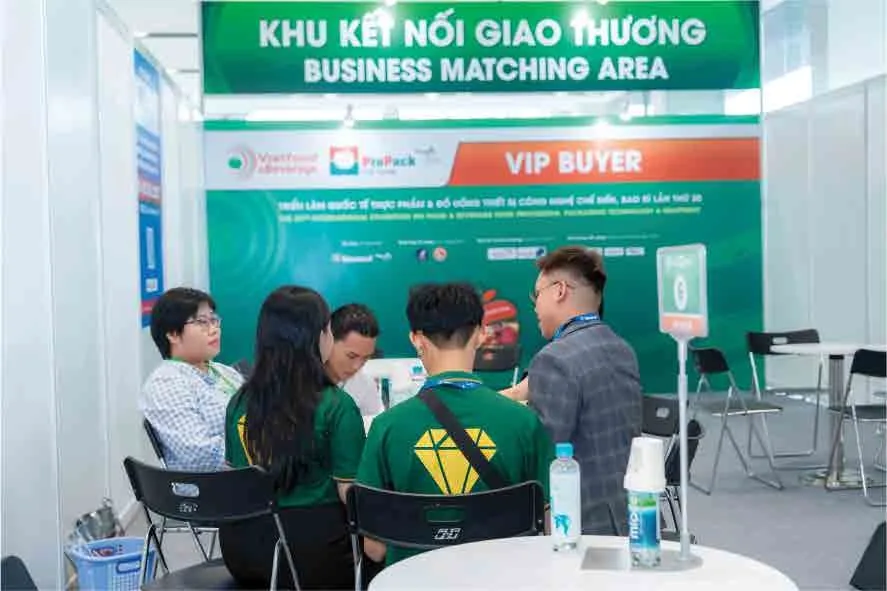
Exhibitors at Vietfood Ho Chi Minh City 2027 often learn that distributors ask first whether the product is already self-declared and labelled. Whether you import yourself or through a distributor, this paperwork is the real gate to the market.
Own Trading Company Or Distributor
| Question | Own trading company | Vietnamese distributor |
|---|---|---|
| Control of price and brand | Full | Shared, set by contract |
| Upfront cost and time | Company formation, capital, staff | Low, contract and samples |
| Who holds product registrations | You | Often the distributor, which can tie you to them |
| Speed to first sale | Slower | Faster if the distributor is active |
| Coverage of north and south | Your choice | Usually one region per distributor |
| Best when | Volume is proven, or the brand needs tight control | Testing the market or entering with limited budget |
One point deserves emphasis. When a distributor self-declares or registers your product in its own name, changing distributor later can mean registering again. Agree in the contract who holds the registrations, or hold them through your own company or a neutral importer.
How To Set Up A Trading Company In Vietnam
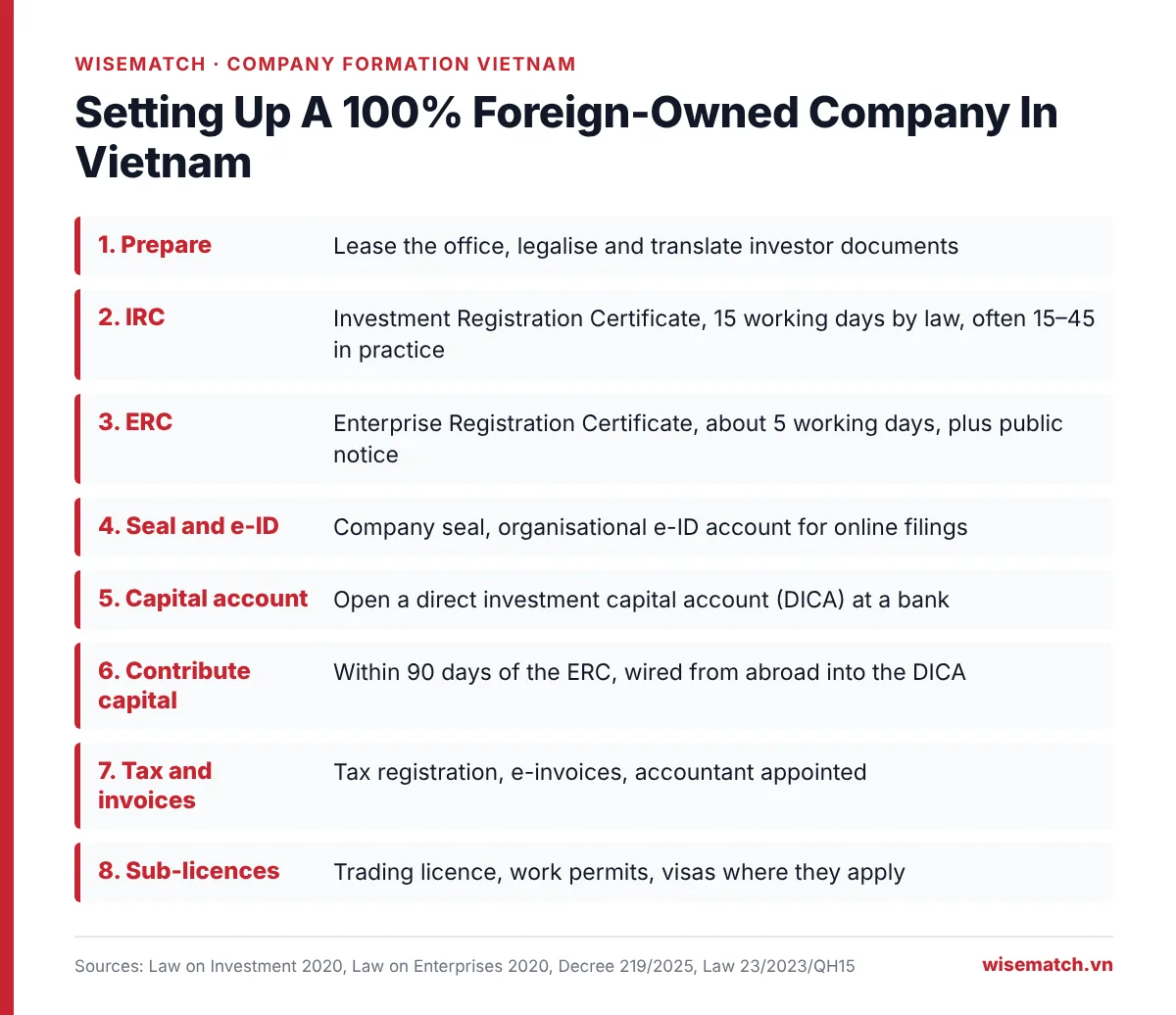
1. Define The Trading Rights
List the goods by HS code and the activities: export, import, wholesale, retail, e-commerce. This decides whether you need only the investment and enterprise certificates, or also a business licence.
2. Form The Company
Obtain the Investment Registration Certificate and the Enterprise Registration Certificate, open a direct investment capital account and contribute capital within 90 days. The full process is in our company formation Vietnam guide.
3. Apply For The Business Licence Where Needed
If you retail or provide trade promotion, brokerage or e-commerce platform services, apply to the provincial People’s Committee under Decree 342/2026.
4. Retail Outlet Licences
For each physical shop, apply for a retail outlet licence where the shop is located. For a second and later shops, prepare for the ENT unless all three exemption conditions are met.
5. Product Compliance
Self-declaration or registration, labels, import inspection, warehouse conditions.
6. Staff And Founders
Foreign managers need work permits or exemptions; an LLC owner contributing VND 3 billion or more is exempt. See our work permit Vietnam guide.
Mistakes We See With New Trading Companies
Retailing On The ERC Alone
Opening a shop, a pop-up store or a consumer website without the business licence is the most common breach, and it exposes the company to fines and suspension.
Listing Goods Too Narrowly
A company licensed for coffee that later wants to import tea or snacks needs an amendment. Describe product groups broadly enough at the start.
Opening A Second Shop Without Checking The ENT
A second shop of 600 m2, or a convenience store format, triggers the needs test even inside a mall. Budget 20 working days for the council’s decision, plus file preparation.
Letting The Distributor Own The Registrations
It is convenient at first and expensive to undo later.
Missing The 15 January And 15 July Reports
New fixed dates, easy to forget in the first year.
How Wisematch Helps
We connect the trade side and the legal side. At the trade fair, we help you meet distributors and buyers. If you decide to import yourself, we set up the trading company, apply for the business licence where needed, and coordinate product self-declaration and labels with partners. Our founder, Maximillien Quan Pham, works with a licensed legal adviser on every file. If you are still deciding how to be present, compare a representative office in Vietnam and read how to start a business in Vietnam as a foreigner.
Frequently Asked Questions About Trading Companies In Vietnam
Can A Foreigner Own 100% Of A Trading Company In Vietnam?
Yes, for most goods, under Vietnam’s WTO commitments. A short list of goods, such as rice, sugar, pharmaceuticals and tobacco, is excluded or restricted.
Does A Trading Company Need A Business Licence?
For import, export and wholesale of most goods, no separate licence is needed beyond the investment and enterprise certificates. Retail, trade promotion, brokerage, e-commerce platforms and some other activities need one under Decree 342/2026.
When Does Decree 342/2026 Take Effect?
On 18 October 2026. It replaces Decree 09/2018/ND-CP.
Who Issues The Business Licence Now?
The provincial People’s Committee where the company’s head office is located.
What Is The Economic Needs Test?
A review by a provincial council before a foreign-invested retailer opens a second or later shop. It applies to investors from countries without a treaty commitment to remove it, and the council decides within 20 working days.
Which Shops Are Exempt From The ENT?
Shops under 500 m2, located in a shopping mall, and not convenience stores, mini-markets or supermarkets. All three conditions must be met.
Do I Need To Register Food Products Before Importing?
Most prepackaged foods are self-declared by the importer. Health supplements, medical foods and infant foods need registration with the Ministry of Health.
Can A Trading Company Sell Online?
Yes, within its licensed scope. Operating a platform for other sellers is a separate activity that needs a business licence.

